
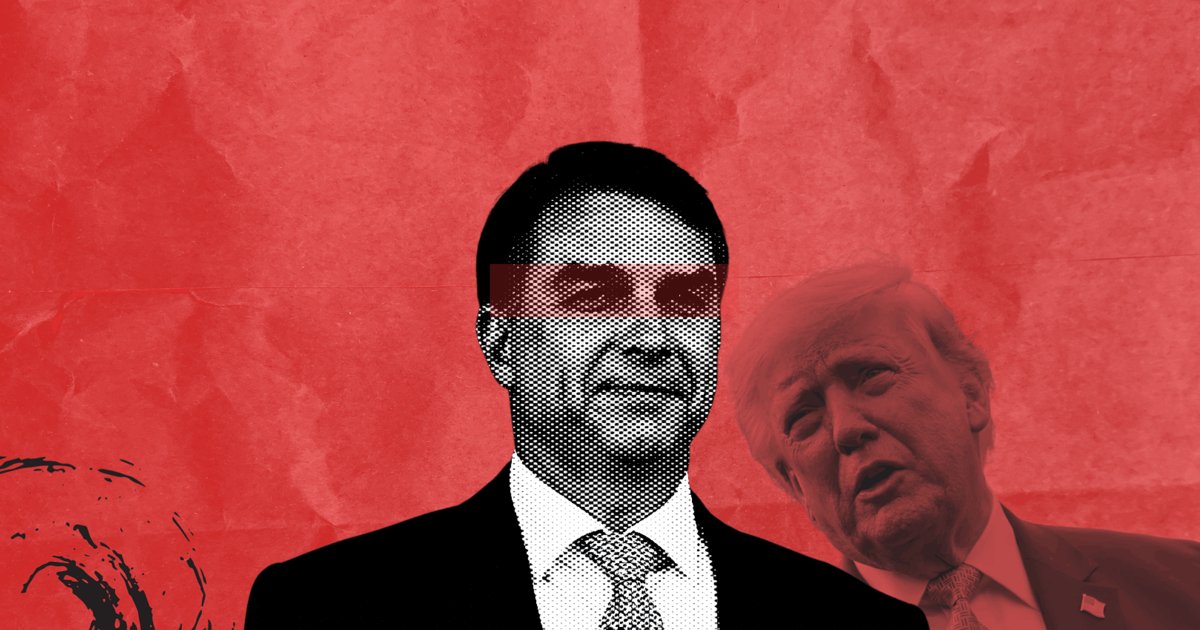

Brazil's 1988 Constitution opens with a principle that is both legally binding and politically fundamental: sovereignty belongs to the people. Its first article establishes that all power emanates from the people, who exercise it through elected representatives or directly, under the Constitution.
It is an affirmation of democratic self-government, but also a statement about the limits of foreign authority over the Brazilian Republic.
Power in Brazil does not originate in Washington. It does not depend on Donald Trump's political preferences, the diplomatic recognition of foreign governments, or the willingness of a defeated presidential candidate to acknowledge the outcome of an election.
This principle has acquired renewed significance following the events of October 2026.
On October 25, President Luiz Inácio Lula da Silva defeated Senator Flávio Bolsonaro in Brazil's presidential runoff, securing a fourth presidential term. Three days later, Bolsonaro, who had left Brazil despite judicial restrictions on international travel, published a letter from the United States challenging the result, accusing Brazilian institutions of orchestrating electoral fraud, and announcing his intention to lead the opposition from abroad.
Early versions of the document presented him as Brazil's rightful president-elect. Subsequent revisions substituted the claim of presidential authority with the assertion that he was the country's rightful leader.
The semantic adjustment matters, but it does not eliminate the underlying political problem. The letter continued to reject the legitimacy of an election whose result had been officially proclaimed and recognized by major domestic political actors, including Bolsonaro's own party.
His appeal to foreign governments raises questions that extend well beyond Brazil's immediate electoral controversy.
What happens when a defeated candidate attempts to relocate a domestic struggle for political legitimacy into the geopolitical arena? What responsibilities accompany the support of millions of voters? And where does legitimate international political engagement end and the potential instrumentalization of foreign power against domestic institutions begin?
Answering these questions requires examining the constitutional foundations of Brazilian democracy, the political meaning of Bolsonaro's departure, and the strategic interests of the United States in Latin America.
1. Nearly 60 million votes, but no presidential mandate
The electoral arithmetic is unambiguous.
According to Brazil's Superior Electoral Court (TSE), Lula received 64,256,232 votes, representing 51.79% of valid ballots. Flávio Bolsonaro obtained 59,826,041 votes, or 48.21%.
The difference was 4,430,191 votes.
These figures reveal two important political realities.
The first is that Lula won the presidential election. His victory provides the democratic and constitutional basis for the continuation of his presidency in the next term. No external recognition is required to make the result legally valid within Brazil.
The second is that Bolsonaro received an extraordinary number of votes. Nearly 60 million Brazilians supported his candidacy, demonstrating the continued electoral relevance of the political movement associated with former President Jair Bolsonaro.
These realities are not contradictory.
A political movement can command extensive popular support and still lose an election. A candidate can represent a substantial portion of society without acquiring the authority to govern.
The distinction lies at the center of representative democracy.
In Losers' Consent: Elections and Democratic Legitimacy (Oxford University Press, 2005), Christopher J. Anderson and his coauthors examine a fundamental democratic problem: elections necessarily produce winners and losers, but the legitimacy of the system depends partly on whether those who lose continue to recognize its rules.
Democratic stability requires more than the ability to organize elections. It also requires that electoral defeat remain compatible with political participation.
Losing an election must not mean losing one's political rights. Equally, retaining political rights must not mean possessing a mandate that voters did not grant.
Bolsonaro's nearly 60 million votes offered him a substantial basis for parliamentary opposition, political organization, public debate, and future electoral competition. They did not confer the Presidency.
Indeed, the magnitude of his support makes his departure especially consequential.
Rather than remaining in Brazil to organize a movement with millions of supporters, Bolsonaro relocated his political activities abroad under circumstances that Brazilian authorities are investigating.
That decision may serve particular political objectives. Yet it also raises a fundamental question of representation: Can a leader who claims to speak for millions of citizens strengthen democratic opposition while distancing himself from the institutions through which those citizens exercise political power?
The answer cannot be determined by rhetoric alone. It depends on conduct, institutional responsibility, and respect for constitutional procedures.
2. The electoral fraud allegation and the burden of evidence
Bolsonaro's letter alleges that the presidential election was manipulated through judicial interference.
His principal argument concerns a Supreme Federal Court decision allowing voting to continue until 7 p.m. in polling stations that were still operating at 5 p.m.
The measure was adopted following reports of transportation difficulties affecting voters. Both presidential campaigns had raised concerns about access to polling stations.
The decision generated procedural controversy, particularly regarding its timing and implementation. Such concerns are legitimate subjects of legal and institutional examination.
But procedural controversy is not synonymous with electoral fraud.
According to official TSE data published on October 27 (external link), 34,393 votes were recorded after 5 p.m.
That number represented approximately 0.78% of the difference between Lula and Bolsonaro.
Even under the mathematically extreme assumption that every ballot recorded after 5 p.m. favored Bolsonaro, the result would remain unchanged.
This calculation does not resolve every possible legal objection concerning electoral procedures. It does, however, demonstrate that the votes recorded during the extended period were insufficient to reverse the outcome.
The distinction is essential. Allegations of illegality must be evaluated through evidence, legal standards, and competent institutions, rather than political declarations.
International election observers also examined the process.
On October 27, the Carter Center commended Brazil's electoral authorities for administering the runoff, while acknowledging complications arising on election day. Its expert mission assessed the conduct and administration of the election without claiming to have independently audited every ballot.
The position of Bolsonaro's own political allies is equally significant.
Senator Rogério Marinho, who coordinated his presidential campaign and leads the opposition in the Senate, stated on October 28 that neither he nor the Liberal Party possessed evidence sufficient to claim electoral fraud.
São Paulo Governor Tarcísio de Freitas, another prominent conservative figure, defended respect for the result.
These reactions reveal that the dispute is not simply between Lula's supporters and Bolsonaro's supporters. It also concerns the boundaries of legitimate opposition within Brazil's political right.
A democracy must allow electoral results to be challenged. But the legitimacy of a challenge depends on the evidence supporting it, not on the political influence of the person making the accusation.
3. The letter: from electoral defeat to a competing claim of legitimacy
The structure of Bolsonaro's letter deserves particular attention.
Rather than merely explaining his departure or proposing an opposition strategy, the document constructs a broader political narrative.
Four elements stand out.
First, Bolsonaro disputes the electoral outcome and presents himself as the legitimate representative of a supposedly defrauded electorate.
Second, he depicts the Brazilian judiciary as an instrument of political persecution, thereby questioning the legitimacy of institutions responsible for adjudicating his legal situation.
Third, he frames his departure as political exile, invoking historical figures who resisted authoritarian governments from abroad.
Finally, he addresses the international community and expresses gratitude to Donald Trump and Argentina's Javier Milei.
These elements are politically connected.
The allegation of electoral fraud supplies the justification for rejecting the result. The accusation of judicial persecution provides an explanation for leaving Brazil. The historical analogies seek to associate his personal circumstances with recognized traditions of resistance. The appeal to foreign actors gives the narrative an international audience.
Together, they establish a rhetorical framework in which electoral defeat is reinterpreted as evidence of institutional illegitimacy.
The changes made to the document are revealing.
According to reporting published on October 29, at least four versions circulated. Initial versions distributed by allies described Bolsonaro as the rightful president-elect. Later versions published through his account replaced the presidential designation with a claim to national leadership.
Even the use of the Brazilian coat of arms became part of the controversy, with different versions containing different official symbols.
These alterations invite scrutiny of how the document was prepared and presented. They do not establish a coordinated international operation, but they demonstrate the political sensitivity of its claims.
A candidate declaring himself president-elect after losing an election is not merely expressing dissatisfaction. He is asserting an authority that has not been conferred through the constitutional electoral process.
That assertion becomes particularly consequential when accompanied by requests for international political support.
4. Leaving Brazil: the difference between exile and accountability
Bolsonaro describes his departure as a necessary response to political persecution.
He argues that he could not exercise effective opposition under the supervision of Brazilian judicial institutions.
The available facts require a more careful distinction between political persecution as an allegation and legal restrictions as documented actions.
On October 28, Brazil's Federal Police confirmed that it had requested precautionary measures from the Supreme Federal Court, including the surrender of passports and a prohibition on leaving the country, in connection with an ongoing investigation.
The police reported that Brazilian passports had been canceled, that a migration alert had been issued, and that Bolsonaro had failed to surrender additional travel documents as required.
The agency also stated that no official record existed of his departure through Brazilian immigration checkpoints.
The circumstances of that departure remain under investigation.
Importantly, the Federal Police clarified that the existence of travel restrictions does not automatically establish that an individual is legally a fugitive or authorize arrest.
Bolsonaro denies wrongdoing and characterizes the proceedings as politically motivated.
These qualifications are indispensable to any serious analysis. Criminal responsibility must be determined through lawful proceedings, not assumed from political disagreement or the existence of an investigation.
Yet the principle of due process applies in both directions.
An investigation does not establish guilt. But an allegation of political persecution does not, by itself, invalidate a judicial order or remove the obligation to respond to competent authorities.
The political significance of the departure is therefore separate from its eventual legal consequences.
A politician with nearly 60 million votes possesses resources for political mobilization that most opposition leaders could never obtain.
Relocating abroad under judicial restrictions may offer international visibility and access to foreign allies. It may also communicate an unwillingness to confront legal and institutional disputes within the political system that his supporters participated in.
Political leadership is not demonstrated simply by invoking courage or sacrifice. It is also measured by accountability, institutional participation, and the capacity to defend political convictions within the legal framework of a democratic state.
The circumstances of Bolsonaro's departure, including possible assistance from other individuals and any irregularities, warrant investigation by the competent authorities.
Unproven suspicions should not be treated as established facts. Equally, political prominence must not exempt anyone from lawful scrutiny.
5. Flávio Bolsonaro is not Juan Guaidó
The letter's invocation of Juan Guaidó is especially relevant to an international audience.
In January 2019, Guaidó, then president of Venezuela's National Assembly, claimed the interim presidency on the basis of a disputed constitutional interpretation following Nicolás Maduro's contested 2018 reelection.
The Trump administration formally recognized Guaidó as interim president. Other governments subsequently followed.
That recognition produced international diplomatic consequences, even though Guaidó never obtained effective control of the Venezuelan state.
The episode illustrates a fundamental distinction in international politics: diplomatic recognition can strengthen a political actor's external standing without automatically conferring effective domestic authority.
But the circumstances in Brazil are materially different.
Bolsonaro was a presidential candidate defeated in an election administered by the country's electoral authorities. He does not preside over an institution claiming constitutional authority to exercise an interim presidency. His party recognized Lula's victory, and no government has formally recognized him as Brazil's president.
The comparison therefore cannot be used to establish an equivalent constitutional claim.
It does, however, reveal the political attractions of internationalizing a domestic dispute.
Foreign recognition, economic assistance, diplomatic access, or political protection can become valuable resources for actors seeking to challenge an incumbent government.
Such support may affect a domestic balance of power. It does not automatically resolve the underlying question of constitutional legitimacy.
The Venezuelan precedent should therefore be examined as a lesson in the possibilities and limitations of external recognition, rather than as evidence that Brazil faces an identical institutional situation.
6. Washington's interests are not Brazil's interests
The international dimension of the controversy cannot be understood without examining the strategic priorities of the United States.
The Trump administration's 2025 National Security Strategy (external link) explicitly seeks to restore American preeminence in the Western Hemisphere.
Under its stated Trump Corollary to the Monroe Doctrine, Washington identifies the need to protect access to strategic locations, prevent rival powers from acquiring sensitive regional assets, and reinforce American influence over security and economic arrangements.
This language reflects a conception of the Western Hemisphere as a strategically privileged area of American foreign policy.
For Latin American governments, it raises enduring questions about regional autonomy, asymmetric interdependence, and the relationship between national development and great-power competition.
Brazil occupies a particularly important position in that environment.
As Latin America's largest economy, it maintains extensive commercial relationships with the United States, China, and the European Union. Its diplomacy participates in institutions including BRICS, the G20, the United Nations, and the World Trade Organization.
Brazil also possesses significant agricultural capacity, energy resources, industrial capabilities, and strategic mineral deposits.
Its foreign policy cannot be reduced to a binary choice between Washington and Beijing. At the same time, its economic position makes the country relevant to both powers.
The competition over critical minerals illustrates this reality.
According to the United States Geological Survey's 2026 assessment, Brazil possesses approximately 21 million metric tons of estimated rare-earth reserves, second only to China.
But geological reserves alone do not establish technological power.
The International Energy Agency reports that, in 2024, China accounted for approximately 60% of global mining of rare earths used in permanent magnets, 91% of refining, and 94% of permanent magnet manufacturing.
The strategic question is therefore not simply who possesses mineral deposits, but who controls the industrial infrastructure needed to transform raw materials into technologies.
Brazil's recently enacted Law No. 15,506 of September 2026, establishing a national policy for critical and strategic minerals, recognizes the importance of expanding domestic industrial processing and technological capabilities.
These developments matter because they place Brazilian resources within a larger competition over supply chains, investment, industrial policy, and technological autonomy.
The Shield of the Americas initiative, whose September 2026 declaration included the protection of critical-mineral supply chains among its objectives, further illustrates Washington's attempt to connect regional security and economic strategy.
Yet recognizing these geopolitical interests does not mean assuming that Bolsonaro's departure was orchestrated by the American government.
The United States has identifiable strategic interests in Brazil. Bolsonaro has identifiable political interests in obtaining international support. Whether those interests translate into coordinated action is a separate empirical question requiring evidence.
That distinction should guide public scrutiny and diplomatic analysis.
7. Economic pressure and the limits of bilateral influence
The geopolitical debate is not entirely hypothetical.
In July 2026, the United States introduced additional tariffs on Brazilian products under Section 301 of its trade legislation.
According to Brazil's Ministry of Development, Industry, Trade and Services, the measures affected approximately 23.1% of Brazilian exports to the American market, based on 2024 trade data.
Washington justified its actions through findings concerning Brazilian practices in areas including digital trade, electronic payments, intellectual property, market access, and forced-labor-related import restrictions.
Brazil rejected the justification for those measures and requested consultations through the World Trade Organization on July 27.
The dispute illustrates how economic asymmetry can shape bilateral political relationships.
The United States possesses considerable financial, technological, and market power. Access to its economy and financial system creates incentives for other countries to accommodate American preferences.
Brazil, however, is not without resources.
Its domestic market, diversified international relationships, agricultural exports, mineral endowments, and diplomatic participation in multilateral institutions provide opportunities to negotiate and resist certain pressures.
The challenge is to understand the difference between legitimate economic bargaining and coercive attempts to influence sovereign political decisions.
Not every tariff is an unlawful act of intervention. International trade law permits particular remedies under established conditions, and governments regularly disagree over the legality of commercial restrictions.
The legal and political context of each measure matters.
Nevertheless, the possibility that trade instruments might be employed to obtain concessions unrelated to legitimate commercial disputes deserves careful examination.
It is precisely this intersection between economic leverage and political autonomy that makes the internationalization of Brazil's post-election controversy significant.
8. Sovereignty, international law, and constitutional legitimacy
Brazil's constitutional framework establishes clear principles for interpreting the controversy.
Article 1 defines sovereignty, citizenship, and political pluralism as foundations of the Republic.
Article 14 establishes the exercise of popular sovereignty through universal suffrage and direct, secret voting.
Article 4 provides that Brazilian international relations must be guided by national independence, self-determination, non-intervention, sovereign equality, peaceful settlement of disputes, and cooperation among peoples.
These principles form an integrated constitutional architecture.
Political pluralism protects the existence of competing ideological projects. Electoral procedures determine which political project receives a particular mandate. The separation of powers constrains the exercise of authority. National independence protects the state against external political subordination.
International law reinforces important elements of this framework.
Article 19 of the Charter of the Organization of American States establishes the principle of non-intervention in the internal or external affairs of other states.
Article 20 addresses coercive economic and political measures intended to force another state's sovereign will.
The application of these provisions to specific conduct requires legal analysis. They do not prohibit ordinary diplomatic criticism, lawful international cooperation, or all economic restrictions.
Nor does sovereignty provide governments with unlimited authority over citizens.
A democratic state remains bound by domestic constitutional guarantees and international human rights obligations.
Indeed, Brazil's Constitution itself places human rights among the principles governing its international relations.
The defense of sovereignty must therefore remain inseparable from the defense of constitutional democracy.
This distinction is essential to avoid reducing national independence to unconditional support for an incumbent government.
Lula's administration is not synonymous with the Brazilian state. Opposition to Lula is not opposition to Brazil. Criticism of the Supreme Court is not inherently an attack on democracy.
But the authority to determine electoral outcomes belongs to Brazilian constitutional institutions, subject to the applicable legal procedures.
Neither a foreign president nor a self-declared domestic leader can simply substitute personal preference for that institutional process.
9. Lula, Bolsonarismo, and the meaning of democratic legitimacy
Lula's political trajectory is relevant to understanding the gravity of the current moment.
From his emergence as a trade union leader during Brazil's military dictatorship to his role in founding the Workers' Party, his first two presidencies between 2003 and 2010, his return to office in 2023, and his reelection in 2026, Lula has remained a central figure in Brazilian political life for more than four decades.
His international prominence reflects his participation in debates on development, inequality, South-South cooperation, climate governance, and the reform of international institutions.
But the constitutional legitimacy of his presidency does not derive from that historical influence.
It derives from the election.
Lula could be internationally influential and still lose an election. Bolsonaro could attract tens of millions of voters and still fail to win the presidency.
This is the essential discipline imposed by democratic politics: personal stature and political ambition must remain subordinate to constitutional procedures.
The same reasoning applies to the enduring political influence of Bolsonarismo.
The movement is not extinguished by Flávio Bolsonaro's defeat. Its voters remain part of the Brazilian political community, entitled to representation, criticism, and participation.
The distinction between opposing a government and rejecting the legitimacy of electoral competition must be preserved.
A democracy depends on the possibility that today's opposition can become tomorrow's government through lawful means.
It also depends on the willingness of today's governing majority to respect the rights of those who opposed it.
As political scientists Steven Levitsky and Daniel Ziblatt argue in their research on democratic norms, mutual toleration requires political competitors to recognize one another's legitimate right to participate and govern when constitutional rules are respected.
That principle applies to all sides.
However, presenting an electoral opponent as fundamentally illegitimate without adequate evidence can erode the political conditions necessary for democratic competition.
The danger is not the existence of a strong opposition. The danger lies in the possibility of transforming electoral defeat into a permanent narrative that constitutional institutions cannot be trusted whenever they produce an unfavorable outcome.
This weakens the system through which political minorities may eventually become majorities.
10. What Brazil must defend
Brazil faces a challenge that is simultaneously institutional, diplomatic, and strategic.
At the institutional level, the priority is the integrity of constitutional procedures.
Electoral authorities must maintain transparency, provide access to verifiable information, and ensure that legal challenges are examined according to established standards.
Judicial authorities must preserve due process, proportionality, and accountability, including in investigations involving prominent political figures.
The circumstances of Bolsonaro's departure must be investigated through ordinary legal mechanisms. Any evidence of irregular assistance, obstruction of justice, or unlawful coordination should be examined according to the law, without presuming guilt.
At the diplomatic level, Brazil must distinguish relations with the American state from the political preferences of a particular administration.
The United States is an important commercial, technological, and diplomatic partner. Bilateral dialogue should remain open even when the governments disagree.
At the same time, Brazil's constitutional legitimacy cannot be treated as a negotiable component of that relationship.
Washington has the right to formulate its own foreign policy. It does not possess the authority to determine Brazilian presidential succession.
At the strategic level, Brazil must continue developing the economic and technological capabilities that reduce external vulnerability.
Diplomatic autonomy depends not only on constitutional principles but also on material conditions: diversified markets, productive capacity, technological knowledge, financial resilience, and the ability to negotiate internationally.
Sovereignty is strengthened when a country can make choices without being excessively dependent on a single external partner.
Brazil's challenge is therefore not to isolate itself from the United States, China, or other powers. It is to cooperate with them while preserving its capacity to define national priorities.
Conclusion — The democratic mandate cannot be exported
The events following Brazil's 2026 presidential election illustrate a broader tension in contemporary international politics: the possibility that domestic struggles over legitimacy become entangled with the strategic interests of foreign powers.
Flávio Bolsonaro received nearly 60 million votes. That gives his political movement substantial democratic relevance.
It does not make him president.
His departure to the United States, the accusations contained in his letter, and his appeal to foreign political figures raise legitimate questions about the responsibilities of democratic opposition and the limits of international political involvement.
Those questions must be investigated and debated without converting suspicion into proof.
The Brazilian public has a right to know the circumstances of his departure, whether judicial orders were violated, and whether any unlawful assistance or external coordination occurred.
But the central constitutional fact remains unchanged.
Lula won the election. Bolsonaro lost.
A presidential mandate cannot be acquired through a declaration drafted abroad, the support of an influential foreign leader, or a political narrative that disregards the announced electoral result.
Brazil's democracy must remain open to opposition, scrutiny, and criticism. It must also preserve the constitutional rules through which political authority is conferred and transferred.
The United States may pursue its interests in Latin America. Brazil may negotiate with Washington, cooperate with its institutions, and maintain strategic disagreements with its government.
Those are matters of diplomacy and international relations.
The presidency of Brazil is a matter of Brazilian constitutional democracy.
All power emanates from the people — not from Washington.
And the sovereign will of the Brazilian electorate cannot be replaced by the political preferences of a foreign government.