
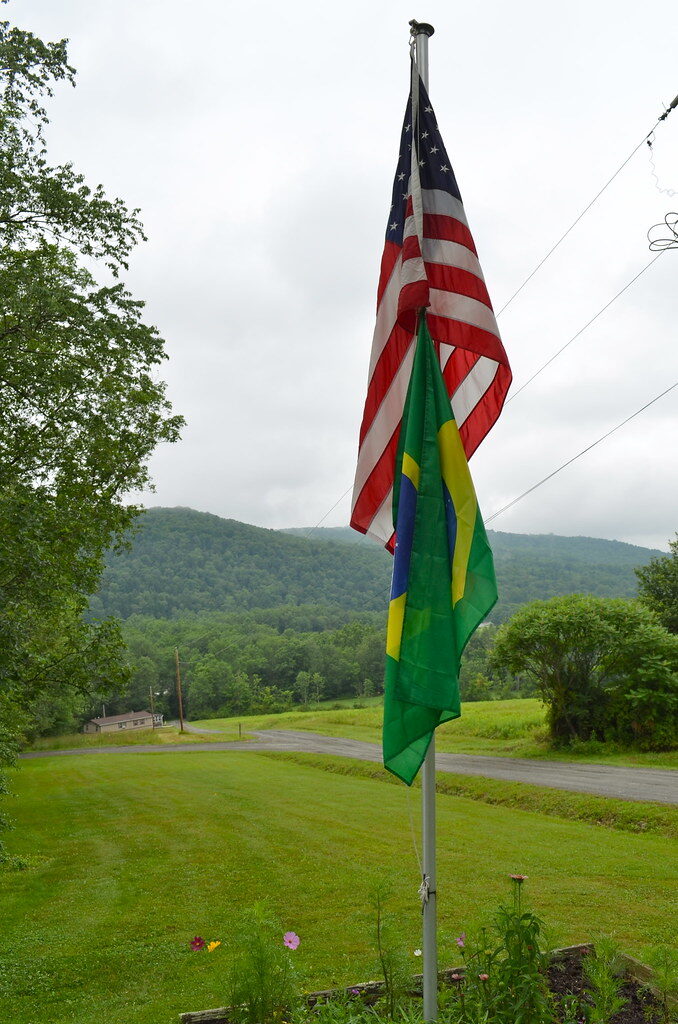
U.S. President Donald Trump has been trying to justify his tariffs by claiming they can help reduce the trade deficits (external link) his country runs with most of the world (external link). That argument rests on the fact that nearly every country sells more to Americans than it buys from the United States.
But the case of Brazil (external link) is different.
The U.S. announced a 25% tariff (external link) on Brazilian goods on July 15, 2026. A second measure, introduced eight days later, added another 12.5 percentage points (external link) to much of that trade. Both took effect on July 24, bringing the tariff total to 37.5% where they overlap.
Here, however, the imbalance runs in the opposite direction. U.S. exports to South America's largest economy have exceeded its imports for years. In 2025 alone, for instance, American companies exported about $54 billion in goods to Brazil (external link), mainly refined fuel, aircraft parts, industrial machinery, fertilizers, and electronics. Flowing the other way, the U.S. imported about $40 billion in Brazilian products, primarily crude oil, semi-finished steel, coffee, orange juice, wood pulp, beef, and passenger aircraft manufactured by Embraer (external link), the world's third-largest aircraft maker.
In total, the U.S. ran a $14 billion trade surplus with Brazil last year.
Despite this, Trump is discouraging U.S. imports of Brazilian goods. And this is his second attempt to do so. In July 2025, he announced a 50% tariff (external link) on Brazilian goods that the U.S. Supreme Court struck down in February 2026 (external link), along with most of his other tariffs.
As scholars of international political economy who analyze U.S. trade policy (external link) and Brazilian trade negotiations (external link), we are examining why the U.S. imposed tariffs on Brazil despite Brazil's trade deficit with the U.S., and how Brazil is responding.
In our view, this dispute has never really been about trade. It began with Trump's objections to a criminal prosecution against former President Jair Bolsonaro (external link)—his political ally in Brazil. Today, with Brazil on the brink of a presidential election, standing up to Washington could prove to be a winning pitch for incumbent President Luiz Inácio Lula da Silva.
Many exceptions
The U.S. government exempted 471 Brazilian products (external link) from the tariffs, including coffee, wood and wood products, crude oil, natural gas, fertilizers, orange juice, and pig iron. Most of the exempt items are commodities and industrial inputs that American buyers would struggle to quickly replace.
What remained on the list are mostly manufactured goods: footwear, apparel, furniture, machinery, and ethanol, the sugarcane-based vehicle fuel. Brazilian footwear and apparel, which compete on price in American stores, received no exemptions.
Although negotiations have stalled, in-person meetings are scheduled for September 30 (external link) on the sidelines of a Group of 20 (G20) meeting in Wisconsin, which will take place shortly before Brazilians head to the polls (external link).
Impact on American businesses
Goods totaling $94 billion (external link) flowed between the two countries in 2025, a volume far smaller than U.S. trade with Canada, Mexico, China, or the European Union. But Brazil ranks among the United States' top 17 trading partners (external link) in terms of goods flows, ahead of Spain, Australia, and Saudi Arabia.
The products still subject to tariffs are largely industrial inputs, rather than off-the-shelf goods. Therefore, the cost of Trump's tariffs falls primarily on American companies, which are responsible for paying them when the goods reach the border.
Top 20 US trade surpluses in 2025
The U.S. ran a $14 billion trade surplus with Brazil, its fifth-largest trading partner, in 2025. That means Brazil spent more on what it imported from the U.S. than it earned from exports to the United States.
Table displaying the top 20 U.S. trade surpluses, including imports and exports.
Table: The Conversation, CC-BY-NDSource: U.S. Census Bureau (external link)Get the dataEmbed (external link)Download image (external link) Created with Datawrapper (external link)
Trump's ability to use tariffs to pressure Brazil into changing policies his administration opposes is limited, as Washington's leverage over Brazil on trade issues has been waning for years. China surpassed the U.S. as Brazil's largest trading partner in 2009 and has widened its lead ever since. In 2025, China bought about 29% of Brazilian exports (external link) and the United States, just 11%.
Brazil's decreasing dependence on the American market limits what Trump's tariffs can achieve. That helps explain why, when Washington imposed tariffs on imports from around the world in 2025, Brazilian exporters were largely able to sell their products to other markets.
The pressure could end up backfiring. In August 2026, White House adviser Peter Navarro and Treasury Secretary Scott Bessent published a report (external link) accusing about 40 economies, including Brazil, of helping China evade U.S. tariffs. But the more Washington restricts Brazilian access to the U.S. market, the more attractive China becomes as a buyer for what Brazil is selling.
Why Trump is targeting Brazil
Trump did not emphasize trade-related concerns when he announced the 50% tariff in July 2025. Instead, he criticized the criminal prosecution of former President Jair Bolsonaro, his ally, in what he called a "witch hunt." (external link) The U.S. government also accused Brazil's Supreme Court of censoring American social media platforms within the South American nation's borders.
Bolsonaro, who once aligned Brasília with Washington, cannot run for president again because he is serving a 27-year sentence (external link) for plotting and attempting a coup d'état. But his son, Senator Flávio Bolsonaro, is in the race.
Flávio Bolsonaro claims he asked Trump not to impose tariffs. But his brother Eduardo Bolsonaro, a former federal deputy, spent months in Washington lobbying the Trump administration to punish Brazilian authorities over the prosecution of their father and supported the imposition of the tariffs (external link).
Even so, poll results point to a dead heat (external link) between Flávio Bolsonaro and Lula. Another 13 lesser-known candidates (external link) are also vying for the presidency.
Responding to Trump's tariffs
After the U.S. Supreme Court struck down the Trump administration's first round of tariffs, the American president attempted to use a different legal instrument: Section 301 (external link) of the Trade Act of 1974. This statute allows a president to take retaliatory measures against foreign practices deemed unfair.
In the second trade investigation, the U.S. imposed additional tariffs on Brazil and 59 other countries (external link), which, according to the Trump administration, were related to the alleged use of forced labor in their supply chains.
Initially, Brazil lacked the means to respond to either of the two rounds of U.S. tariffs.
However, in 2025, the Brazilian Congress passed a new “economic reciprocity (external link)” law modeled on the rationale of Section 301. It allows the Executive Branch to determine whether a measure taken by a foreign country harms Brazilian competitiveness. If so, the government may impose tariffs as countermeasures or suspend intellectual property-related obligations.
Brazil initiated its first proceeding (external link) under this law on August 13, 2026. The proceeding is against the United States.
Of course, opening a proceeding does not guarantee that Brazil will retaliate. The procedure involves seven administrative stages that, together, can take more than six months.
Brazil is also pursuing a slower multilateral strategy. The country brought the dispute to the World Trade Organization (WTO) (external link), the Geneva-based body that establishes and enforces global trade rules. The first stage of any WTO dispute is a round of formal negotiations known as consultations, which the two governments are required to hold before the dispute can move forward.
Since consultations with Washington ended in August without an agreement, Brazil says it will request the establishment of a formal WTO dispute panel (external link), which will decide whether the U.S. tariffs violate the organization's rules.
China has also joined the complaint, with India, Indonesia, South Africa, Colombia, and Egypt joining as third parties.
Why Brazil may not retaliate
We consider it unlikely that Brazil will take any official retaliatory action against the U.S., given the inherent power imbalance.
The U.S. consumer market is far larger than Brazil's, and other asymmetries exist. The dollar-based financial system and Washington's control over critical technologies give the United States the means to escalate trade disputes in ways Brazil cannot bypass. A trade dispute could spill into areas where Brazil has no way to respond in kind.
Canada's situation illustrates what this alternative would look like. Following the collapse of trade negotiations with Washington, Ottawa responded to U.S. tariffs in August 2026 with tariffs of up to 50% on hundreds of U.S. products (external link), deepening a trade war between two countries that were once among the closest trading partners in the world. Canada sends roughly three-quarters of its exports to the United States (external link), giving its retaliation real leverage—even if those tariffs could harm its own economy. Brazil does not enjoy such leverage.
Even if Brazil never retaliates, the steps it is taking in that direction allow the government to demonstrate to voters that it is taking action.
Lula's approval ratings, which had been declining, rebounded after he placed national sovereignty (external link) at the center of his response to Washington. His aides state they do not expect a deal with Washington to lift the tariffs (external link) prior to the October 4 elections (external link).
And whether Brazil will ever trigger its version of Section 301 to address what it views as unfair trade practices may depend on who wins the Brazilian presidential election.
This article, “Os EUA vendem mais para o Brasil do que compram, mas ainda assim Trump está impondo tarifas elevadas às exportações brasileiras”, by Filipe Mendonça and Henrique Menezes, was originally published in The Conversation and is licensed under Creative Commons (CC BY-ND 4.0). Original publication: The Conversation — “Os EUA vendem mais para o Brasil do que compram...” (external link)