
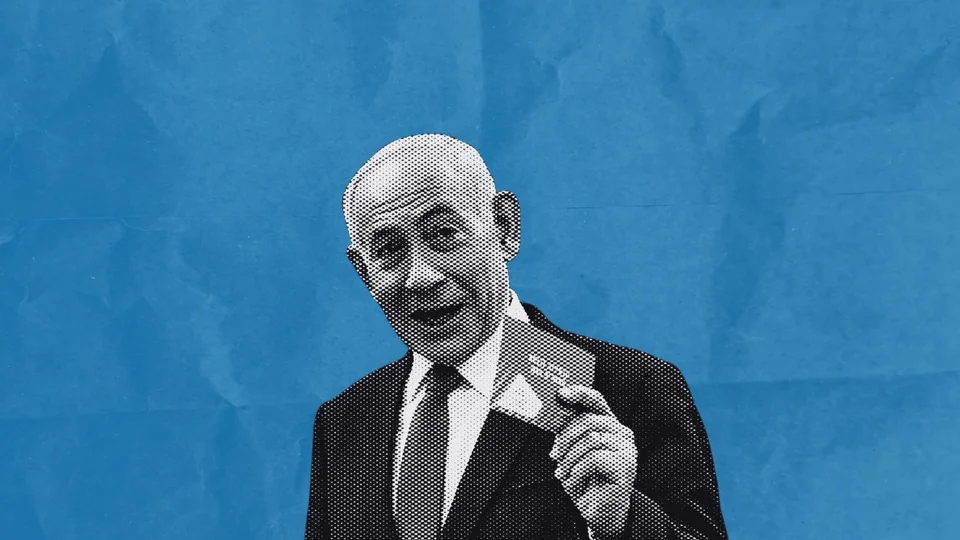

Israel has voted. Benjamin Netanyahu has lost his governing majority. The opposition has failed to secure power. And Palestinian citizens of Israel have achieved something that few expected: they now hold the parliamentary seats that could determine the country's next government.
The October 27 election has produced one of the most consequential political deadlocks in recent Israeli history. It has also revealed a deeper contradiction within Israel's political system.
Palestinian citizens, whose participation has frequently been marginalized in coalition politics, have become essential to the distribution of parliamentary power. Yet millions of Palestinians in the occupied territories remain unable to vote in Israeli national elections, despite living under policies and military decisions made by Israeli governments.
The outcome is therefore about much more than Netanyahu's political survival.
The election has changed the balance of power in Israel. Whether it will change the exercise of power over Palestinians is an entirely different question.
The Results: Netanyahu Lost His Majority, but Not His Power
The final vote count delivered 53 seats to Netanyahu's political bloc, 48 to the Jewish-led opposition headed by Gadi Eisenkot, and 19 to the Arab-led parties, the Joint List and Ra'am.
A majority in the 120-member Knesset requires 61 seats.
Netanyahu's Likud remains the largest party, with 27 seats, while Eisenkot's Yashar secured 21. Naftali Bennett's B'Yachad won 12, the Joint List 11, and Ra'am eight.
The governing bloc, which held 64 seats following the 2022 election, has consequently suffered a substantial parliamentary defeat. Yet Netanyahu remains prime minister in a caretaker capacity until another government takes office.
The country's overall voter turnout reached 77.9%, compared with 70.6% in 2022. The most remarkable political development, however, was the surge in participation among Arab citizens.
The Israel Democracy Institute estimates that turnout in Arab and Druze localities reached approximately 77%, compared with 53.2% four years earlier. In some Bedouin communities in the Negev, participation approached 80%.
This extraordinary mobilization nearly doubled the representation of Arab-led parties, from ten seats in the previous Knesset to nineteen.
The arithmetic is straightforward: the Jewish-led opposition and Arab-led parties collectively control 67 seats.
But the political equation is not.
The Palestinian Vote: A Historic Result With Uncertain Power
The most significant outcome of the election may not be Netanyahu's loss of parliamentary support. It may be the ability of Palestinian citizens to transform their electoral participation into political influence.
Arik Rudnitzky, a researcher at the Israel Democracy Institute, argues in a November 3 analysis that the record turnout reflects accumulated frustration with government policies, discrimination, political marginalization, and insecurity within Arab communities.
According to the institute's research, 78.5% of Arab respondents expressed pessimism about the future of democratic governance in Israel shortly before the election.
Economic concerns also played a central role. High levels of crime, inadequate public services, housing shortages, and home demolitions have become important issues motivating political participation.
The remarkable turnout therefore cannot be reduced to a simple anti-Netanyahu protest. It also represents demands for citizenship, equality, and public accountability.
For Palestinian citizens, participation offers a means to influence the government responsible for their everyday lives. But this creates a difficult political paradox.
They can vote. They can elect parliamentary representatives. Their parties may even decide who becomes prime minister.
Yet several major Jewish-led parties continue to reject governing with their representatives.
Palestinian commentator Abed Abou Shhadeh, writing for Al Jazeera on November 2, describes this contradiction through the distinction between formal political inclusion and practical exclusion.
His argument challenges the assumption that possessing voting rights necessarily guarantees equal political influence.
This is the central tension exposed by the October 2026 election: Palestinian citizens have demonstrated their electoral importance, but it remains uncertain whether the political establishment will recognize that influence in the formation of a government.
The Dispute Over Electoral Legitimacy
The days following the vote introduced another conflict.
Netanyahu's Likud alleged that Arab-led political parties had benefited from illegal electoral activities and possible foreign financing involving Qatar and Turkey.
Israeli security authorities opened an investigation into specific allegations. Qatar denied the accusations.
But the country's electoral institutions have explicitly rejected suggestions that the election results should be invalidated.
On November 1, Central Elections Committee chairman Noam Sohlberg stated that the elections had been properly conducted and that the results reflected the will of voters. He also made clear that the investigation did not justify collective suspicion of Arab communities.
The distinction is fundamental. Investigating possible offenses is a legitimate institutional responsibility. Treating unproven allegations as grounds to dismiss an entire community's electoral participation is a different matter.
Gadi Eisenkot accused Netanyahu of attempting to delegitimize the result.
Political scientist Aaron David Miller, writing for the Carnegie Endowment on October 29, highlighted how the campaign against Arab political participation had become entangled with the struggle to form a government.
This institutional confrontation has broader implications.
A 2025 study by Yael Shomer, Eitan Tzelgov, and Roi Zur in Frontiers in Political Science examined the weakening of checks and balances, judicial restructuring, and political polarization in Israel. Their analysis demonstrates that institutional tensions cannot be separated from debates over the concentration of executive power.
The October election has brought these disagreements into a new phase: the legitimacy of the electoral process itself has become part of the political contest.
What Analysts Say About Netanyahu's Future
The immediate question is whether Netanyahu can survive the loss of his majority.
Analysts offer different interpretations of his position.
Elliott Abrams, a senior fellow at the Council on Foreign Relations and former American national security official, described the election as simultaneously an electoral setback and a political opportunity for Netanyahu.
In his October 29 analysis, Abrams emphasized that Likud remains the largest party and that Netanyahu could benefit from prolonged coalition negotiations. His principal argument is that the incumbent may remain in a stronger negotiating position than the parliamentary numbers initially suggest.
Aaron David Miller reaches a related, though more cautious, assessment. Netanyahu remains in office while negotiations continue, and another election could provide an opportunity to recover political ground.
But there is another possibility.
The opposition could construct a government with Ra'am participating directly and the Joint List supporting it from outside. Israeli political history provides precedents for minority governments dependent on Arab parliamentary support.
The obstacle is political willingness.
On November 2, Avigdor Lieberman announced support for Eisenkot's candidacy while reiterating his refusal to participate in a government dependent on Arab parties.
This leaves Eisenkot with a difficult choice: revise earlier commitments, negotiate a broader coalition, or risk allowing Netanyahu to remain in office.
The next institutional steps are already scheduled. Official results are to be presented to President Isaac Herzog on November 4, and the new Knesset is expected to convene on November 10.
The president must then assign a member of parliament the task of forming a government. The first candidate normally receives 28 days, with a possible extension of up to 14 days.
The election has ended, but the competition for executive power has only begun.
Would Eisenkot Change Israel's Policy Toward Palestine?
This is where the analysis must move beyond the conventional narrative of Netanyahu versus the opposition.
A change in government could produce meaningful differences in Israeli domestic policy, judicial independence, diplomatic relations, and the treatment of Palestinian citizens.
But it would be misleading to assume that Eisenkot represents a fundamentally different approach to Palestinian sovereignty.
Both Netanyahu and Eisenkot oppose the establishment of an independent Palestinian state under their proposed policies. Both advocate maintaining Israeli security control across the territory between the Mediterranean Sea and the Jordan River.
Their differences concern important aspects of implementation.
Eisenkot has criticized unauthorized settlement outposts, pledged to restrain violence by settlers, and opposed the E1 settlement project in the occupied West Bank. Netanyahu's coalition, by contrast, includes parties advocating territorial annexation and the expansion of Israeli control.
These distinctions matter, particularly for communities facing displacement and violence.
Natan Sachs, a Middle East Institute analyst interviewed by Vox on November 3, argues that an Eisenkot government should not be treated as equivalent to Netanyahu's. He expects differences in the use of military force, relations with Arab citizens, and institutional governance.
From this perspective, even a government unwilling to recognize Palestinian statehood could reduce certain forms of violence and reverse policies that have undermined Palestinian communities.
Palestinian analyst Yousef Munayyer, however, raises a more structural objection.
His criticism emphasizes the millions of Palestinians living under Israeli control without participation in Israel's political institutions. Electoral inclusion within Israel does not resolve the question of political rights in the occupied territories.
These interpretations should not be collapsed into a single conclusion.
A different government could make a significant practical difference to Palestinian lives without fundamentally resolving the conditions of occupation.
Political moderation is not the same as Palestinian self-determination.
Four Scenarios for the Coming Months
The election opens several plausible political paths, none of which should be mistaken for a confirmed outcome.
Scenario One: An Eisenkot Government With Arab Support
Ra'am could join an Eisenkot-led coalition while the Joint List provides parliamentary backing.
This would represent a significant development in the political participation of Palestinian citizens and might create opportunities for greater public investment, legal protections, and institutional reform.
But the coalition would contain parties with sharply different views on settlements, Gaza, and Palestinian sovereignty. Its capacity to pursue fundamental territorial change would remain limited.
Scenario Two: A National Unity Government
Netanyahu's Likud and major opposition parties could negotiate a broader government.
Such an arrangement might reduce institutional instability and restore diplomatic coordination with Washington and regional partners.
The principal risk would be policy continuity. A government capable of improving Israel's international image might still maintain military control and settlement policies in the occupied territories.
Scenario Three: Netanyahu Retains Power
Netanyahu could attempt to attract defectors from the opposition or reach agreements with parties outside his existing bloc.
His coalition partners would likely press for continued settlement expansion and assertive regional security policies.
This scenario could deepen diplomatic disagreements over the occupied territories and increase the prospect of further confrontation with Palestinian communities.
Scenario Four: Political Deadlock and Another Election
If coalition negotiations fail, Israel could hold another election in 2027.
Netanyahu would remain caretaker prime minister, while the new Knesset could potentially exercise legislative power against his political interests.
A prolonged impasse could also leave the government's existing territorial and security policies largely unchanged.
The critical variable across all four scenarios is whether the emergence of a new parliamentary majority translates into a new political direction.
The International Consequences: Washington, Iran, and the Global South
Israel's elections matter beyond its borders because the country occupies a central position in the military and diplomatic organization of the Middle East.
American military support, confrontation with Iran, relations with neighboring Arab states, and Israeli operations in Gaza, Lebanon, and Syria shape regional security calculations.
The Congressional Research Service warned in its October 30 assessment that Israel's political transition could affect relations with the United States, regional stability, and debates within Congress over military assistance.
Yet the document also identifies substantial continuity in the security priorities of Netanyahu's opponents.
A new government might adopt a more cooperative diplomatic approach while preserving military doctrines developed during previous administrations.
For Washington, this could facilitate regional partnerships. For Palestinians, however, the essential question would remain whether diplomacy produces meaningful changes on the ground.
Countries across Africa, Asia, and Latin America also have reasons to closely examine the outcome.
The Global South is not a unified political bloc. Governments hold different positions on Israel, Palestine, regional security, and relations with the United States.
Nevertheless, the Palestinian question remains central to debates about sovereignty, decolonization, territorial acquisition, and the consistency of international law.
In July 2024, the International Court of Justice concluded that Israel's continued presence in the Occupied Palestinian Territory was unlawful and affirmed the Palestinian people's right to self-determination.
That legal assessment does not depend on the electoral success or failure of Netanyahu.
Nor would it cease to matter if Eisenkot formed a government supported by Palestinian citizens of Israel.
The obligations associated with occupation, civilian protection, settlement activity, and Palestinian rights remain relevant regardless of which coalition assumes office.
Beyond Netanyahu: The Question Israel's Election Cannot Resolve
The October 2026 election has demonstrated both the importance and the limits of electoral politics in Israel.
Netanyahu has lost his parliamentary majority but remains in power. The opposition possesses a potential numerical majority but must overcome its own political divisions. Palestinian citizens have achieved unprecedented representation, yet their legitimacy as governing partners remains contested.
These developments will shape Israel's immediate political future.
But the long-term significance of the election will be measured by more demanding questions.
Will Palestinian citizens gain substantive political influence? Will the next government restrain settlement expansion and violence against Palestinian communities? Will it change its approach to Gaza and the occupied West Bank? Will it recognize a credible political horizon for Palestinian self-determination?
International observers should avoid confusing a change in political leadership with a transformation in political structures.
Israel's occupation policies, regional security doctrine, and strategic alliance with Washington have developed across multiple governments and electoral cycles.
Ending Netanyahu's premiership would therefore be an important political development. It would not automatically constitute a new Israeli policy toward Palestine.
The October election has already transformed the parliamentary arithmetic. Whether it can transform the country's political future remains uncertain.
And that is the central paradox of this moment.
Palestinian citizens have demonstrated that their votes can determine who governs Israel. But the future of peace will ultimately depend on whether Palestinians, including those excluded from Israel's national elections, gain meaningful control over their own political destiny.